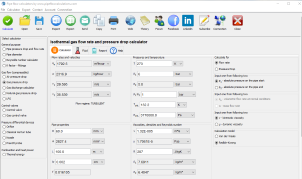
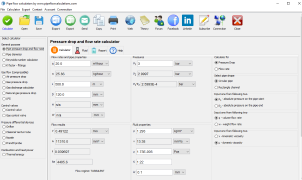

When Should You Use This Air Flow and Pressure Drop Calculator?
This calculator is ideal for estimating air flow through pipelines or determining the pressure drop of air as it moves through a pipe. It supports round cross-section pipelines and is applicable to both laminar and turbulent flow conditions.
Calculator Limitations
This tool assumes isothermal flow, meaning the air temperature remains constant along the pipeline, even with pressure changes. This assumption holds when the pipeline is:
- Long and straight, with minimal cross-sectional changes
- Uninsulated and exposed to ambient conditions
In cases of slow or steady airflow, any cooling from pressure drop is naturally balanced by heat exchange with the surrounding environment. As a result, the air maintains a stable temperature during flow.
How Does the Calculator Work?
The calculation is based on the isothermal flow equation for an ideal gas. Here's what the calculator evaluates:
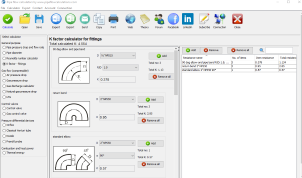
- 1️⃣ Friction factor (f) and local resistance coefficient (K)
- 2️⃣ Reynolds number (Re) to determine the flow regime (laminar or turbulent)
- 3️⃣ Air velocity at both the inlet and outlet of the pipe
- 4️⃣ Total pressure drop across the pipeline
You’ll receive detailed output showing the flow regime, Reynolds number, and velocities at both ends of the pipeline.
When Not to Use This Calculator
This tool does not support adiabatic flow conditions—where temperature changes due to significant pressure drops. It is not suitable for:
- Flows with large pressure drops (e.g., leaks, narrow openings, or sonic flow)
- Situations where altitude changes significantly affect air density
- Scenarios requiring potential energy changes due to elevation differences
These conditions invalidate the assumption of constant temperature and may require more advanced thermodynamic modeling.
Required Input Information
- 📌 To calculate pressure drop, you must enter the air flow rate
- 📌 To calculate air flow, you need to enter the expected pressure drop
- 📌 Accurate results depend on entering realistic and compatible values based on your specific pipeline configuration.