
Reynolds number calculator
laminar or turbulent flow

Registration
Select a fair price and enable the full service:
- Switch between metric and imperial units in one click
- Export calculation results in Word .docx or Excel .xlsx format
- Preview results on one place and copy/paste it in your favorite text editor
- Send results back to your email
- Support the future of this project
And even more... get access to the full set of 19 desktop calculators available for Windows / macOS.
Full Year Service
Prepaid Monthly Cost
$3.33/month
Full year $39.95/year
When is this calculator suitable?
You can use the calculator for all fluids and flow rates without any restriction. The calculator applies to fluid mixtures also, but you have to enter the viscosity of a mixture.
Calculator description
Reynolds number named after Osborne Reynolds (1842 – 1912), gives the relation between inertial and viscous forces of fluid flow. If inertial forces (flow rate) are much bigger, and Reynolds number is higher than critical, Re > 2320, fluid flow is turbulent, and if viscous forces are big enough in comparison to inertial (flow rate), Reynolds number is lower than critical, Re < 2320, fluid flow is laminar.
For calculation of Reynolds number in closed pipe fluid flow average velocity, fluid viscosity, and internal pipe diameter should be known. Reynolds number is proportional to fluid flow average velocity and pipe diameter and inversely proportional to fluid viscosity.
With Reynolds number calculator you can analyze what makes fluid flow regime laminar and what is needed to force the fluid to flow in the turbulent regime. For example - in pipes with minimal internal diameter it is more likely to have laminar flow regime with small Reynolds number even for a fluid with low viscosity. In fluid flow with temperature change flow regime can change from turbulent to laminar flow regime, as viscosity is changing depending on the fluid temperature.
Register account and unlock full access
Desktop App
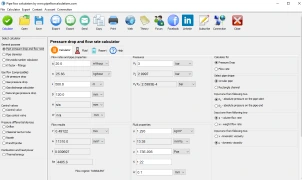
Fast. Accurate. Reliable.
Features in desktop app
- Save/Open multiple results
- Export to Word and Excel
- Print results
- Create list of custom fluid properties
- Resistance factor K for valves/fittings
- Pipe surface roughness selection
- Pipe material selection
- Gauge vs absolute pressure toggle
- Compressible isothermal flow
- Dry air isothermal flow
- Gas offtake flow
- Natural gas flow
- No admin rights required to install
Need a helping hand?
Powered by natural intelligence - NI

If you need a quick calculation, but you are not still familiar how to use the calculator, you can order calculation service from the calculator developer.