
Venturi tube flow calculator
flow rate measurement calculator
online since 2000
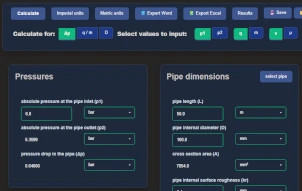
Desktop App
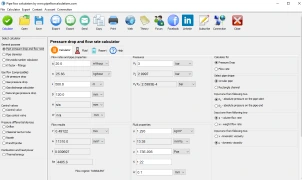
Desktop full-featured version.
Free Trial Available
Registration
Select a fair price and enable the full service:
- Switch between metric and imperial units in one click
- Export calculation results in Word .docx or Excel .xlsx format
- Preview results on one place and copy/paste it in your favorite text editor
- Send results back to your email
- Support the future of this project
And even more... get access to the full set of 19 desktop calculators available for MacOS, Linux or Windows.
Full Year Service
Prepaid Monthly Cost
$3.33/month
Full year $39.95/year
Why should you use this calculator?
Use this calculator to quickly calculate the actual flow rate through the Venturi tube flow meter with only a few inputs. This calculator performs the flow rate calculation from the measured pressure difference caused by the flow contraction in the throat of the Venturi tube.
Due to the contraction in the diameter from the inlet to the throat of the Venturi tube, the flow velocity is changing while flow rate remains constant. That change in flow velocity is creating the increase of the dynamic pressure and drop of the static pressure, as total pressure remains uniform, according to the conservation law.
The change of the static pressure can be easily measured. That measured value is the input value for the calculation of the flow rate in the Venturi tube. You should measure pressure in front of the Venturi and the Venturi's throat and use that value in the calculator.
This calculator also calculates total pressure drop created by the Venturi tube, although it is much lower than in other pressure differential metering devices like an orifice.
You can use the calculator for the Venturi effect (change of the static pressure due to the flow stream contraction) analysis, also. Many devices like Venturi vacuum pump, gas burners, wine aerator, aspirators, grills, and others use Venturi effect for their operation. These devices are creating the drop in static pressure, and that pressure change is inducing the flow of the other fluid.
When is this calculator suitable?
The calculator is relevant for a subsonic flow single-phase liquid or ideal gases. It is not applicable for pulsating flow, or non-steady flow when the flow rate is changing in time.
When is this calculator not relevant?
This calculator is not suitable for flow of multiphase fluids, like a stream of liquids that contain solid particles or stream of liquids that contain undissolved gases. Also, it is not suitable for gases that are not ideal, i.e., gases that don't relate to the ideal gas law.
Limiting factor for Venturi effect is when the flow reaches chocked flow and mean velocity is close to the local speed of sound.
What has to be understood to perform the calculation?
To calculate flow rate, you have to enter the Venturi tube inlet and throat diameter, together with fluid properties - density and viscosity.
For a gas as flowing fluid, instead of the density, you can enter gas constant, pressure and temperature at actual conditions. Density is then calculated using a perfect gas state equation.
You should enter density on real flow conditions - real pressure and real temperature.
How is the calculation executed?
The calculator is doing calculation according to ISO 5167-4.
You can expect to have accurate and reliable results solely if the Venturi tube satisfies the requirements from the standard.
What are the standard ISO 5137-4 conditions?
For the flow of a perfect gas, the pressure reduction produced by the Venturi tube (p2/p1) must be higher than 0.75.
Limits of use for Venturi tube with an "as cast" convergent section are:
100 mm < D < 800 mm
0.3 < β < 0.75
2x10⁵ < ReD < 2x10⁶
Limits of use for Venturi tube with a rough welded sheet iron convergent section are:
200 mm < D < 1200 mm
0.4 < β < 0.7
2x10⁵ < ReD < 2x10⁶
Limits of use for Venturi tube with machined convergent section are:
50 mm < D < 250 mm
0.4 < β < 0.75
2x10⁵ < ReD < 1x10⁶
where is:
β - diameter ratio d/D
What happens if a calculation is not within these limits?
If the Venturi tube characteristics or flow conditions are not according to the ISO 5167-4 calculator presents the message. If you still want to perform calculation regardless of the conditions in the standard, you can choose not to use ISO constraints in the calculation.
Register account and unlock full access
Desktop App
Fast. Accurate. Reliable.
Features in desktop app
- Save/Open multiple results
- Export to Word and Excel
- Print results
- Create list of custom fluid properties
- Resistance factor K for valves/fittings
- Pipe surface roughness selection
- Pipe material selection
- Gauge vs absolute pressure toggle
- Compressible isothermal flow
- Dry air isothermal flow
- Gas offtake flow
- Natural gas flow
- No admin rights required to install
Need a helping hand?
Powered by natural intelligence - NI

If you need a quick calculation, but you are not still familiar how to use the calculator, you can order calculation service from the calculator developer.