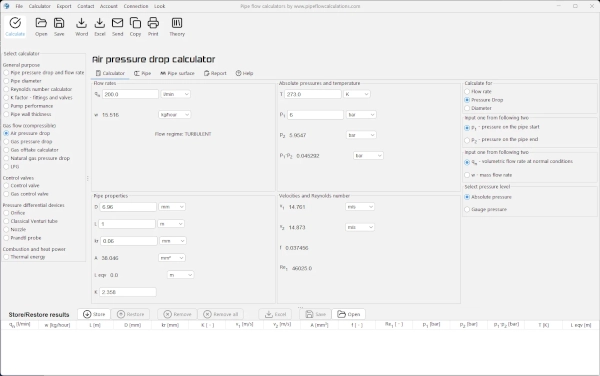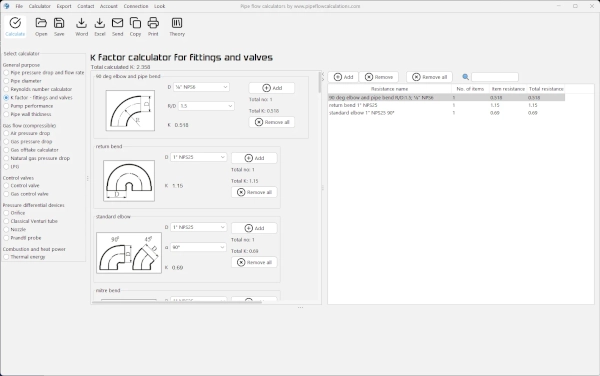
Flow Calculator For Compressible Flow Of Gases
Calculate Isothermal Gas Pressure Drop and Flow Rate
Online Calculator
This calculator is not available as Online app.
Desktop App
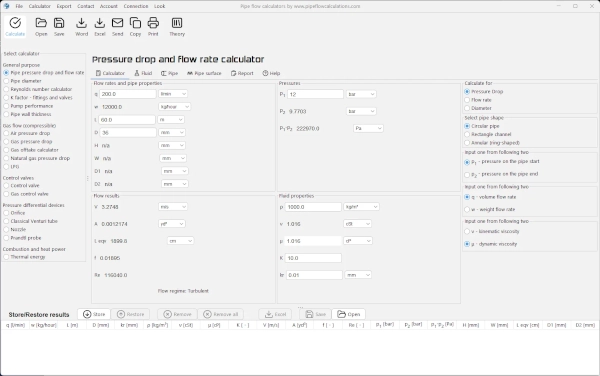
Desktop full-featured version.
Registration
Select a fair price and enable the full service:
- Switch between metric and imperial units in one click
- Export calculation results in Word .docx or Excel .xlsx format
- Preview results on one place and copy/paste it in your favorite text editor
- Send results back to your email
- Support the future of this project
And even more... get access to the full set of 19 desktop calculators available for Windows / macOS.
Full Year Service
Prepaid Monthly Cost
$2.50/month
Full year $29.95/year for new users and renewals before expiry
Why Use This Calculator?
Accurately calculating gas flow rate and pressure drop is crucial in designing and optimizing pipelines, ventilation systems, and gas distribution networks. This calculator helps determine these values for any gas flowing through a round, closed pipe by applying standard engineering principles.
With this tool, you can:
- ✔ Ensure proper pipe sizing and avoid excessive pressure losses
- ✔ Optimize system efficiency and minimize energy costs
- ✔ Understand flow behavior under different conditions
- ✔ Improve accuracy in engineering calculations
Whether you’re designing a system, troubleshooting flow issues, or optimizing an industrial process, this calculator provides quick and reliable results.
When Is This Calculator Useful?
This tool is suitable for gases such as:
- Air, nitrogen, oxygen, carbon dioxide
- Natural gas, methane, propane, hydrogen
- Helium, argon, ammonia, and other process gases
It applies to both laminar and turbulent flow regimes, making it useful in industries like oil and gas, HVAC, chemical processing, and power generation.
How Does the Calculation Work?
This calculator assumes that gas temperature remains constant, regardless of the pressure drop. While real-world systems may experience temperature changes due to pressure variations, this model is accurate for:
- Long pipelines without sudden changes in conditions
- Pipes with thermal insulation that prevent heat loss
- Steady-state flow, where external heat exchange compensates for pressure-related cooling
However, for systems where temperature changes significantly due to rapid compression or expansion, an adiabatic flow model would be required.
Volumetric vs. Mass Flow Rate: Understanding the Relationship
Gas flow rate can be expressed as:
- 1️⃣ Volumetric flow rate (Q): Measured in m³/s, L/min, or SCFM
- 2️⃣ Mass flow rate (ṁ): Measured in kg/s, lb/min, or g/h
The relationship between these is given by:
Where:
- ṁ = Mass flow rate (kg/s)
- Q = Volumetric flow rate (m³/s)
- ρ = Gas density (kg/m³)
Conversion Between Volumetric and Mass Flow Rate
To convert between the two:
Gas density can be calculated using the ideal gas law:
Where:
- P = Absolute pressure (Pa)
- Z = Compressibility factor
- R = Specific gas constant (J/kg·K)
- T = Absolute temperature (K)
Calculator Limitations
This calculator is not suitable for:
- Adiabatic flow, where temperature changes due to pressure variations
- Sudden flow restrictions causing abrupt pressure changes
- Systems with significant elevation differences
What Inputs Are Required?
To perform a calculation, enter:
- 📌 For pressure drop calculation: Flow rate and pipe diameter
- 📌 For flow rate calculation: Pressure drop and pipe diameter
- 📌 To convert between volumetric and mass flow: Gas density at operating conditions
Accurate inputs ensure precise calculations for pipeline design and optimization.


Desktop App
Fast. Accurate. Reliable.
Features in desktop app
- Save/Open multiple results
- Export to Word and Excel
- Print results
- Create list of custom fluid properties
- Resistance factor K for valves/fittings
- Pipe surface roughness selection
- Pipe material selection
- Gauge vs absolute pressure toggle
- Compressible isothermal flow
- Dry air isothermal flow
- Gas offtake flow
- Natural gas flow
- No admin rights required to install
Need a helping hand?
Powered by natural intelligence - NI

If you need a quick calculation, but you are not still familiar how to use the calculator, you can order calculation service from the calculator developer.