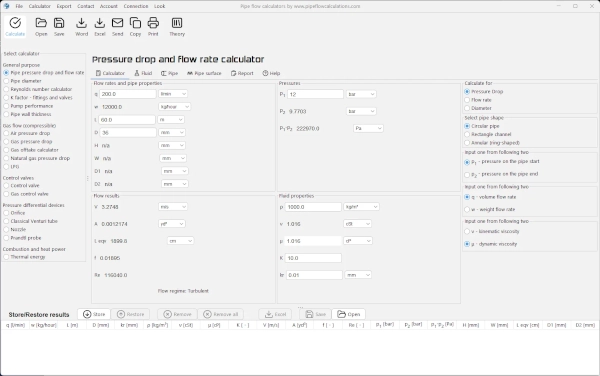
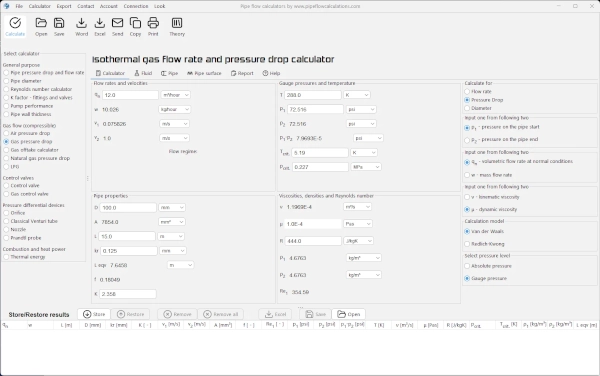
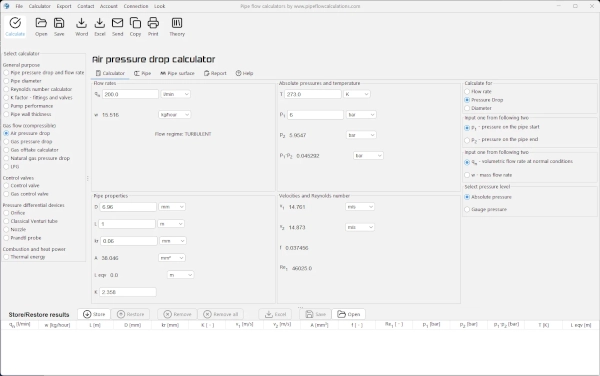
Description
- q - volumetric flow rate
- Fluid flow rate in terms of units of volume per unit of time
- ṁ - mass flow rate
- Fluid flow rate in terms of units of mass per unit of time
- V - velocity
- Flow velocity in terms of units of distance per unit of time
- D - pipe diameter
- Internal circular pipe diameter
- H - channel height
- The height of channel for rectangle shaped pipe
- W - channel width
- The width of channel for rectangle shape pipe
- A - area
- Internal pipe cross section area
- ρ - fluid density
- Mass per unit of volume
- T - temperature
- Fluid temperature for gas density calculation based on the ideal gas state equation
- p - pressure
- Fluid pressure at the start of the pipe for gas density calculation based on the ideal gas state equation
- R - gas constant
- Gas constant in terms of energy per unit of mass and temperature, for gas density calculation using ideal gas state equation
- ν - kinematic viscosity
- Result of fluid particles colliding to each other and moving at different velocities in terms of area per square unit of time
- μ - dynamic viscosity
- Result of fluid particles colliding to each other and moving at different velocities in terms of mass per square unit of distance and time
- Re - Reynolds number
- Dimensionless number representing viscous versus inertial forces ratio
Calculation Setup
Configure the parameters below to calculate flow rate, flow velocity, and
related fluid properties. The calculator automatically computes all
non-selected variables, ensuring a flexible and accurate setup for both
liquid and gas flow calculations.
-
Select the value you want to enter. The remaining two values will be
calculated automatically based on your input.
- q
- Volumetric flow rate.
- ṁ
- Mass flow rate.
- V
- Flow velocity inside the pipe.
-
Select the value you want to input. The other will be calculated
automatically. This option is available only when the selected fluid
is a gas.
- ρ
- Fluid density.
- T
- Fluid temperature.
-
Select which viscosity value you want to enter. The calculator will
determine the other viscosity property automatically.
- ν
- Kinematic viscosity.
- μ
- Dynamic viscosity.
- Select the fluid type for the calculation.
- liquid
- For incompressible fluids where density remains constant.
- gas
-
For compressible fluids where the ideal gas equation applies.
Enables choosing whether density or temperature will be entered.
- Select pipe shape
- round pipe
- full cross section fluid flow
- rectangular duct
- for rectangle channels and full cross section flow
When is This Reynolds Number Calculator Suitable?
The Reynolds number calculator can be used for all types of fluids and flow rates without restriction.
It applies to fluid mixtures, requiring the density and viscosity of the mixture.
Whether analyzing flow in a pipe as laminar or turbulent, this tool helps engineers determine the flow regime
by evaluating the ratio of inertial forces to viscous forces. Using characteristic length, it assesses how inertial
forces to viscous forces influence fluid behavior in pipelines and closed systems.
What is Reynolds Number?
The Reynolds number, named after Osborne Reynolds (1842–1912), represents the relationship between
inertial and viscous forces in fluid flow.
- If the Reynolds number is greater than 2320 (Re > 2320), the flow is turbulent.
- If the Reynolds number is less than 2320 (Re < 2320), the flow is laminar.
The transition between laminar and turbulent flow occurs at Reynolds numbers near 2000–4000, depending on the system conditions.
Once the flow regime is known, the pipe diameter is critical in determining velocity and Reynolds number.
Use the
Pipe Diameter Calculator
to size the pipe based on flow rate and velocity.
How Does the Reynolds Number Calculator Work?
To calculate the Reynolds number, the following parameters are required:
- Fluid velocity (V) – The average velocity of the fluid.
- Pipe diameter (D) – The internal diameter of the pipe.
- Fluid viscosity (μ) – The dynamic viscosity of the fluid.
- Fluid density (ρ) – If needed, kinematic viscosity (ν = μ/ρ) can be used instead of dynamic viscosity.
The formula for Reynolds number is:
Re = (ρ × V × D) / μ or Re = (V × D) / ν
Example Calculation
For a pipeline with:
- Fluid velocity: 2 m/s
- Pipe diameter: 0.05 m
- Dynamic viscosity: 0.001 Pa·s
- Fluid density: 1000 kg/m³
The Reynolds number is calculated as:
Re = (1000 × 2 × 0.05) / 0.001 = 100,000
Since Re > 2320, the flow is turbulent.
Why is Reynolds Number Important?
The Reynolds number is a key parameter in fluid dynamics because it helps predict how fluids behave in different
conditions:
- In small-diameter pipes, laminar flow is more likely, even with low-viscosity fluids.
- With temperature changes, viscosity varies, causing the flow regime to shift between laminar and turbulent.
- Understanding flow regime is critical in engineering applications like pipe design, heat exchangers, and fluid transport systems.
How to Use the Reynolds Number Calculator?
Follow these simple steps to determine the flow regime using our Reynolds number calculator:
- Enter the fluid velocity in meters per second (m/s).
- Input the internal pipe diameter in meters (m).
- Provide the fluid viscosity (either dynamic or kinematic viscosity).
- Click the calculate button to get the Reynolds number.
- Compare the result with the critical Reynolds number (2320) to determine if the flow is laminar or turbulent.
Key Takeaways
- The Reynolds number helps classify fluid flow as laminar (smooth) or turbulent (chaotic).
- It is influenced by fluid velocity, pipe diameter, and viscosity.
- Use the Reynolds number calculator to predict flow behavior in pipelines and fluid systems.
With this Reynolds number calculator, you can quickly analyze flow characteristics and make informed decisions in
engineering applications.